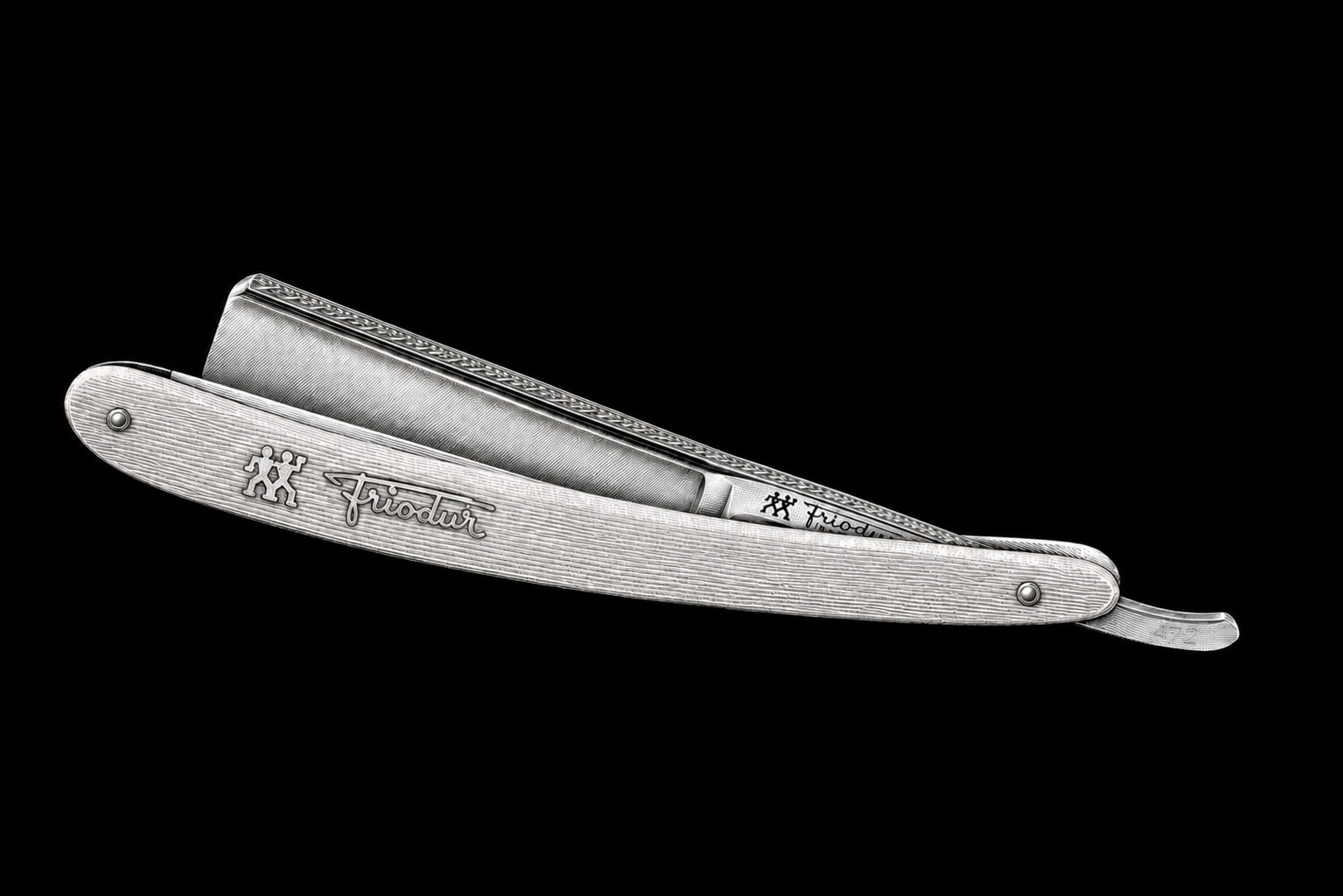
Friodur 472 — Japan-market 13/16-inch specimen
This vintage Zwilling J.A. Henckels Friodur 472 specimen is described by its seller as made for the Japanese market. The listing gives a 13/16-inch width, a 2.75-inch cutting edge, and a full-hollow grind, and describes ornamental engraving on the spine and upper tang. It does not give a production date.
Specifications
- Grind
- Full hollow
Record details
History & details
History
A collector account links Friodur to a Henckels hardening patent from 1939; it does not date the selected specimen.
The collector places Friodur treatment in razor making after WWII, between the mid-50s and through the 60s; this line context does not date the selected specimen.
Historical context
The seller describes this specimen as made for the Japanese market.
The seller lists this specimen at 13/16 inch wide; this measurement is specific to the listed razor.
The seller lists the cutting edge at 2.75 inches.
A collector reported that a separate 472 measured 13/16 inch including its spine; this supports treating width as specimen-specific.
A collector post groups 472 and 230 razors as 6/8 examples with decorated tangs; this is a general collector convention, not a measurement of the selected specimen.
Design and construction
The listing describes ornamental engraving across the spine and upper tang of this specimen.
The seller describes the razor's original scales as mostly straight but does not identify their material.
The seller identifies the steel as Friodur Inox, with the description “No Stain.” No chemical composition is established for this specimen.
Sources & record details
- The seller describes this specimen as made for the Japanese market.
- The seller lists this specimen at 13/16 inch wide; this measurement is specific to the listed razor.
- The seller lists the cutting edge at 2.75 inches.
- The listing describes ornamental engraving across the spine and upper tang of this specimen.
- The seller describes the razor's original scales as mostly straight but does not identify their material.
- A collector reported that a separate 472 measured 13/16 inch including its spine; this supports treating width as specimen-specific.
- A collector post groups 472 and 230 razors as 6/8 examples with decorated tangs; this is a general collector convention, not a measurement of the selected specimen.
- A collector account links Friodur to a Henckels hardening patent from 1939; it does not date the selected specimen.
- The collector places Friodur treatment in razor making after WWII, between the mid-50s and through the 60s; this line context does not date the selected specimen.
- The seller identifies the steel as Friodur Inox, with the description “No Stain.” No chemical composition is established for this specimen.