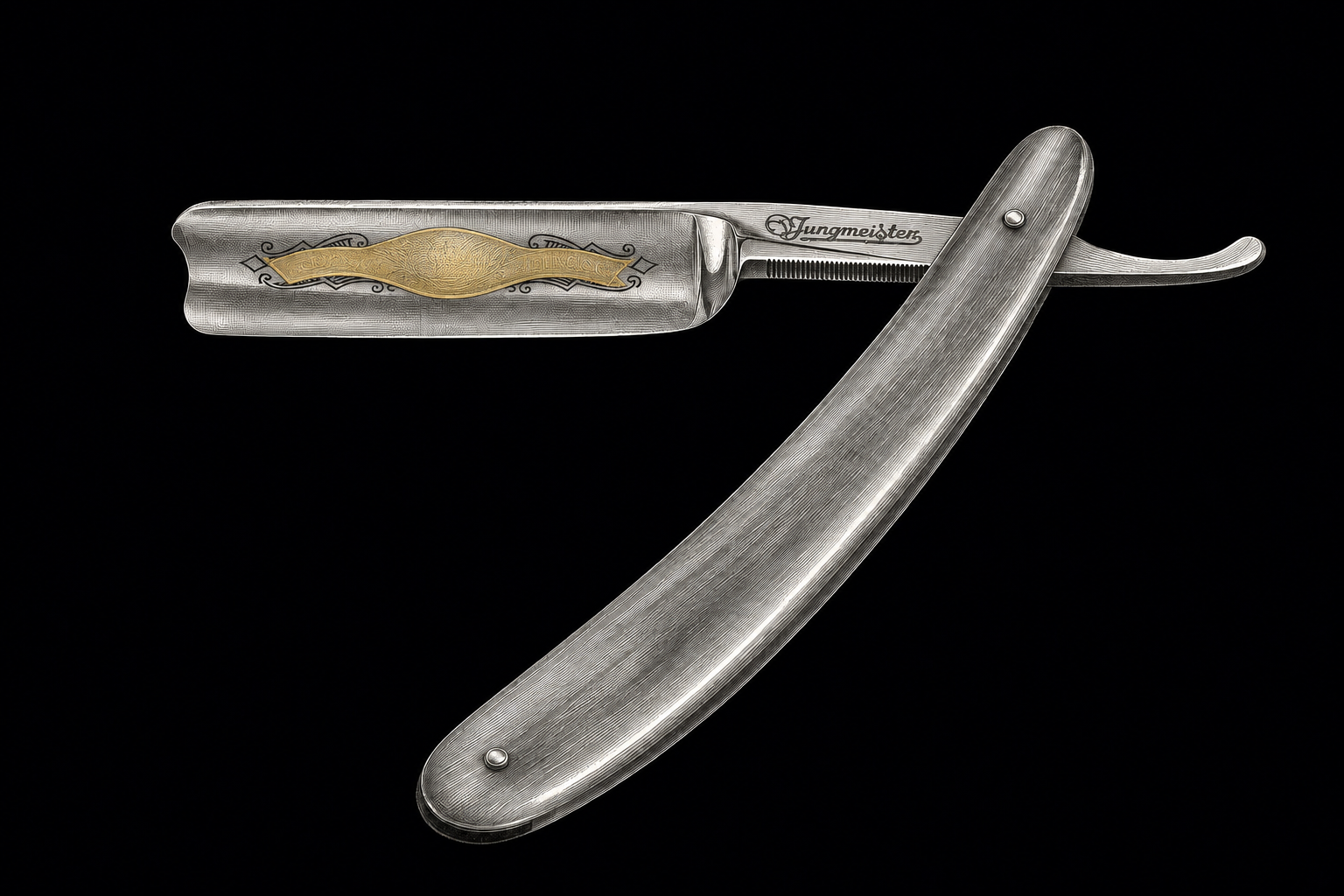
Jungmeister 7/8 (Commons documented handcrafted example)
Wacker
Wacker dates establishment of the Jungmeister razor-market brand to 1940. The selected documented example is a handcrafted 7/8 razor captioned as made by Heribert Wacker in Solingen.
Specifications
- Width
- 7/8″
Record details
History & details
History
Karl Wacker established the Jungmeister razor-market brand in 1940.
Design and construction
The Commons caption identifies the selected example as a handcrafted Jungmeister made by Heribert Wacker in Solingen.
The maker says Jungmeister razors remain fully committed to traditional forms, in contrast to modern design and material approaches under the Wacker mark.
Another collector describes a Jungmeister 7/8 with a full hollow grind, Spanish point, engraved spine, ram-horn scales, and an ebony wedge.
Dating and identification
The maker dates establishment of the Jungmeister brand to 1940; this is not a date for the photographed razor.
Recorded curiosities
A collector post glosses “Jungmeister” as “young master” and says the trademark was still used by Wacker when the post was written.
Sources & record details
- Karl Wacker established the Jungmeister razor-market brand in 1940.
- The maker dates establishment of the Jungmeister brand to 1940; this is not a date for the photographed razor.
- The Commons caption identifies the selected example as a handcrafted Jungmeister made by Heribert Wacker in Solingen.
- The maker says Jungmeister razors remain fully committed to traditional forms, in contrast to modern design and material approaches under the Wacker mark.
- A collector post glosses “Jungmeister” as “young master” and says the trademark was still used by Wacker when the post was written.
- Another collector describes a Jungmeister 7/8 with a full hollow grind, Spanish point, engraved spine, ram-horn scales, and an ebony wedge.
About the maker
History
The Wacker family interview dates establishment of the business in Solingen to 1940.
The family interview says Heribert Wacker trained as a razor grinder at Dorko in Solingen from 1953.
The maker's brochure describes the Wacker family business as making traditional razors in its fourth generation and says all production steps are done by hand.
The family interview says Johannes Wacker joined the business in 2006 as its fourth generation and trained as a razor grinder with his father.
Historical context
The maker says its razors carry the “Made in Solingen” quality mark.
Design and construction
Wacker calls its characteristic grinding form Wall- & Taillenschliff. This is the brochure’s general account of the maker’s work, rather than an Allround-specific factory specification.
Sources & record details
- The Wacker family interview dates establishment of the business in Solingen to 1940.
- The family interview says Heribert Wacker trained as a razor grinder at Dorko in Solingen from 1953.
- The maker's brochure describes the Wacker family business as making traditional razors in its fourth generation and says all production steps are done by hand.
- The family interview says Johannes Wacker joined the business in 2006 as its fourth generation and trained as a razor grinder with his father.
- Wacker calls its characteristic grinding form Wall- & Taillenschliff. This is the brochure’s general account of the maker’s work, rather than an Allround-specific factory specification.
- The maker says its razors carry the “Made in Solingen” quality mark.
Sources
- maker_site
- forum
- user
- forum
- user

Image sources
Based on a photograph by Frank Schulenburg. Original photograph · CC BY-SA 3.0.
Adapted as an illustration. This adaptation is shared under the same licence.
Last updated 2026-11-16 · Suggest a correction