Celebrated Army Razor (Auckland Museum object 1956.2)
M. Hunter & Son
An Auckland Museum record documents a M. Hunter & Son razor and associated case bearing the wording Celebrated Army Razor.
Specifications
- Scales
- Bone
Record details
History & details
History
The Auckland Museum record identifies the razor and case as M. Hunter and Son and transcribes the case-side product wording as “Celebrated Army Razor” and “Talbot Works Sheffield.” The Army wording alone does not prove military issue.
Historical context
The museum record transcribes the case wording as “CELEBRATED ARMY RAZOR - TALBOT WORKS SHEFFIELD.”
Design and construction
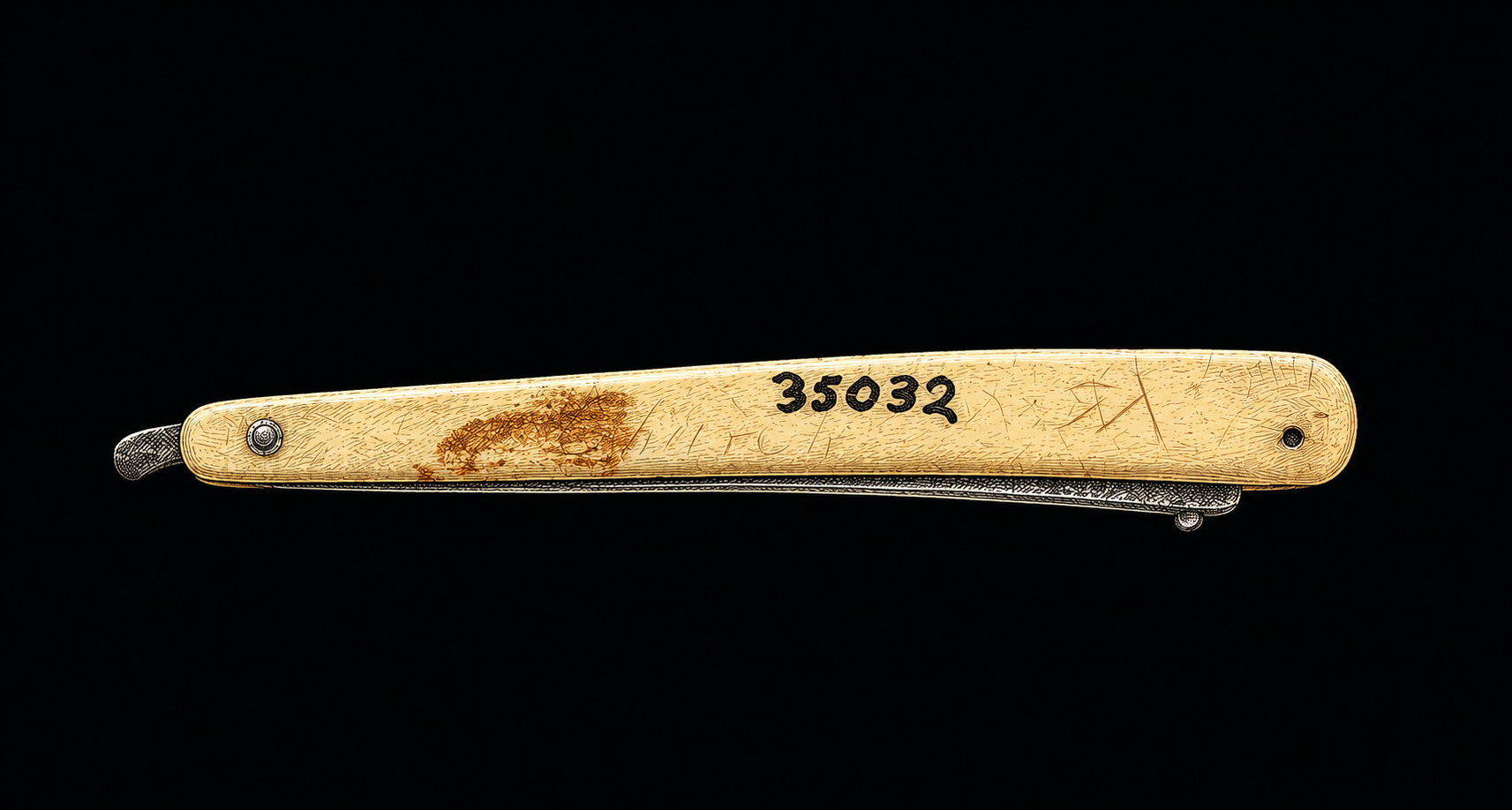
Auckland Museum describes the razor as having a bone handle with hand engraving on both sides.
The associated case is described by the museum as black cardboard with a lid. The selected photograph shows the razor closed without the case, so this is object-record context rather than a visual claim about the image.
Dating and identification
Auckland Museum dates this razor-and-case object to circa 1800; this is its catalogue dating, not a dated factory record for the named razor.
Sources & record details
- The Auckland Museum record identifies the razor and case as M. Hunter and Son and transcribes the case-side product wording as “Celebrated Army Razor” and “Talbot Works Sheffield.” The Army wording alone does not prove military issue.
- Auckland Museum dates this razor-and-case object to circa 1800; this is its catalogue dating, not a dated factory record for the named razor.
- Auckland Museum describes the razor as having a bone handle with hand engraving on both sides.
- The associated case is described by the museum as black cardboard with a lid. The selected photograph shows the razor closed without the case, so this is object-record context rather than a visual claim about the image.
- The museum record transcribes the case wording as “CELEBRATED ARMY RAZOR - TALBOT WORKS SHEFFIELD.”
About the maker
History
Hawley Sheffield Knives reports that one cited source dates the start of Hunter & Son to 1780, with the formation of Hunter & Twigg; this is an attributed company chronology, not a date for the Army Razor object.
Historical context
Hawley Sheffield Knives says the firm made or factored razors among a wider cutlery range. This describes the maker, not a specification of the museum razor.
Sheffield Archives lists c. 1860 price-list and pattern records covering razors and scissors for Michael Hunter and Son.
Sheffield Archives also lists an illustrated catalogue and price list dated 1912 for Michael Hunter and Son, including razors among its described contents.
A Wellington Independent notice describes M. Hunter & Son as Sheffield manufacturers of razors and scissors among other cutlery and metal goods.
The advertisement identifies Thomas Paine as a Melbourne hardware importer and says the undersigned offered Hunter & Son’s latest patterns.
Sources & record details
- Hawley Sheffield Knives reports that one cited source dates the start of Hunter & Son to 1780, with the formation of Hunter & Twigg; this is an attributed company chronology, not a date for the Army Razor object.
- Hawley Sheffield Knives says the firm made or factored razors among a wider cutlery range. This describes the maker, not a specification of the museum razor.
- Sheffield Archives lists c. 1860 price-list and pattern records covering razors and scissors for Michael Hunter and Son.
- Sheffield Archives also lists an illustrated catalogue and price list dated 1912 for Michael Hunter and Son, including razors among its described contents.
- A Wellington Independent notice describes M. Hunter & Son as Sheffield manufacturers of razors and scissors among other cutlery and metal goods.
- The advertisement identifies Thomas Paine as a Melbourne hardware importer and says the undersigned offered Hunter & Son’s latest patterns.
Sources
- user
- user
- catalog
- catalog
- user


Image sources
Based on a photograph by Auckland Museum. Original photograph · CC BY 4.0.
Adapted as an illustration.
Last updated 2026-11-16 · Suggest a correction