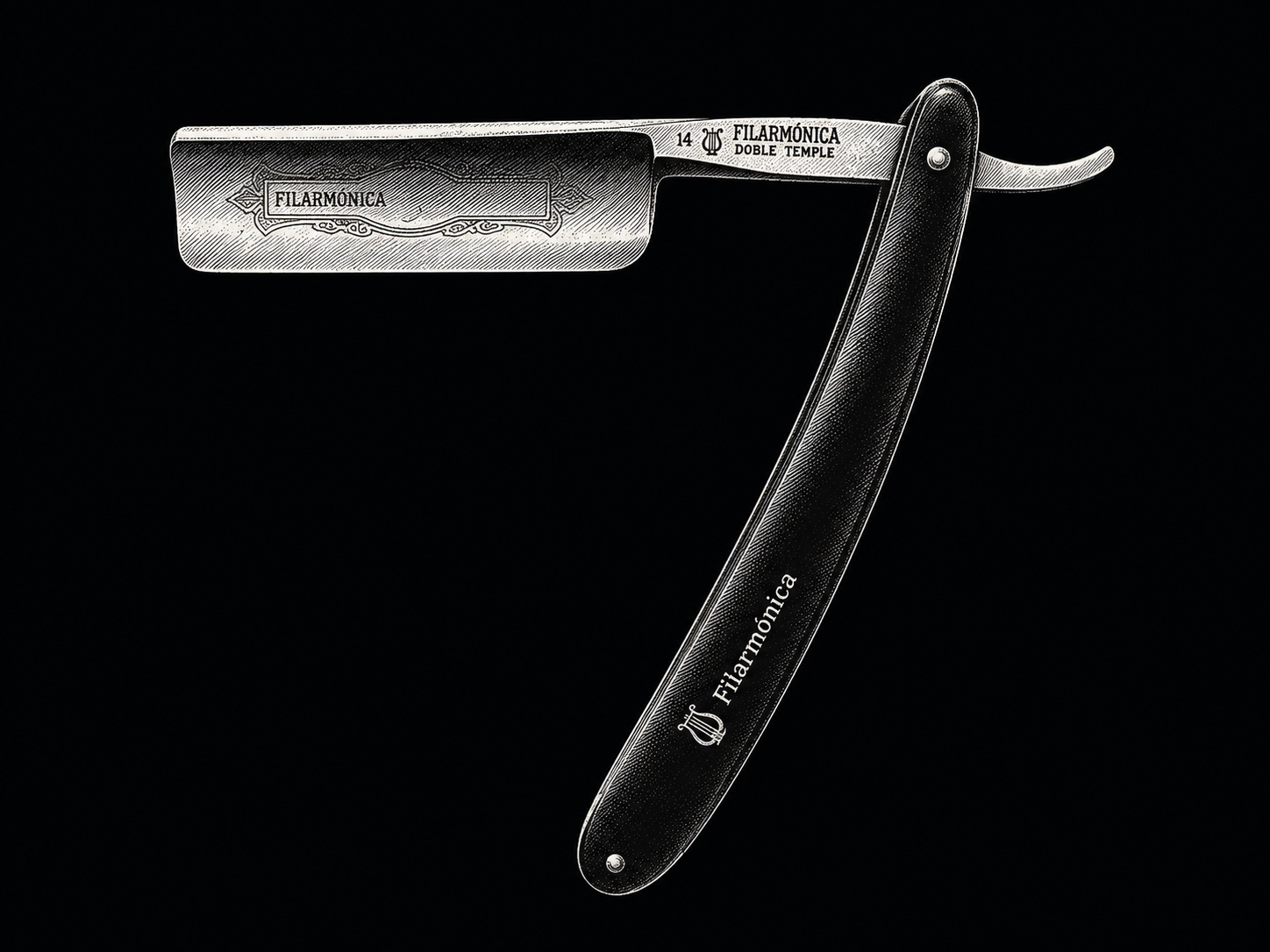
Filarmónica 14 Doble Temple — 8/8 offered example (listing 1268)
This 8/8 Filarmónica 14 Doble Temple has a hollow-ground blade and an American point, according to the seller. The No. 14 family is also documented in museum collections, while collectors distinguish examples by their tang stamps, blade emblems and decorative scales.
Specifications
- Width
- 8/8″
Record details
History & details
History
A separate Museo del Traje object carries the inscription FILARMONICA (arpa) DOBLE TEMPLE. This confirms the mark on that museum specimen, not the exact stamp layout of the selected offered item.
Historical context
Filarmónica Doble Temple shaving razors had a life beyond the barber's chair. In an account of Asturian jet carving, an official Spanish heritage resolution recalls them as especially prized, sought-after and costly. It singles out shaving razors, which the account regarded as more resistant than hair-cutting razors.
The seller identifies the selected item's country of origin as Spain.
Design and construction
For the selected offered example, the retailer lists a hollow grind but does not specify its degree.
The retailer describes this razor as having an American point.
The retailer calls the scales artificial but gives no exact substance, so no particular plastic or resin is inferred for this razor.
The museum record interprets the razor's tang mark 14 as blade width, normally expressed in eighths of an inch; this interpretation is not a measurement of the selected offered item.
For the separate museum razor, the catalogue describes a concave-edge steel blade, gold-inlaid cartouche and straight point. These object-specific features are not transferred to the selected offered item.
Dating and identification
The Museo del Traje dates its separate Filarmónica accession to circa 1915. This is not a date for the selected offered razor.
A collector guide, disclosed as a translated repost, treats a curved José Monserrat Pou stamp, straight Filarmónica stamp and vertical No. mark as first-generation identifiers; this is a provisional collector scheme, not an established factory chronology.
The same reposted collector guide says an early gold medallion bore centered JMP initials and was later replaced by a lyre. Its chronology remains unverified and is not assigned to the selected offered item.
Collectors also compare the JMP seal with the lyre emblem when identifying early Doble Temple examples. One photo-based discussion proposed an early date from the JMP seal; this remains a collector's interpretation, not a factory date.
Recorded curiosities
Filarmónica 14 razors also entered contemporary art: a MUSAC gallery label records 23 double-tempered steel examples in an installation by Darío Corbeira.
In a photo-based discussion, collectors reported other Doble Temple examples with deer, squirrel and peacock motifs, as well as translucent red, green and blue and opaque scales. The thread also records uncertainty about whether some scales were original; none of these variants is attributed to the selected offered item.
Sources & record details
- Filarmónica Doble Temple shaving razors had a life beyond the barber's chair. In an account of Asturian jet carving, an official Spanish heritage resolution recalls them as especially prized, sought-after and costly. It singles out shaving razors, which the account regarded as more resistant than hair-cutting razors.
- Filarmónica 14 razors also entered contemporary art: a MUSAC gallery label records 23 double-tempered steel examples in an installation by Darío Corbeira.
- For the selected offered example, the retailer lists a hollow grind but does not specify its degree.
- The retailer describes this razor as having an American point.
- The retailer calls the scales artificial but gives no exact substance, so no particular plastic or resin is inferred for this razor.
- The seller identifies the selected item's country of origin as Spain.
- A separate Museo del Traje object carries the inscription FILARMONICA (arpa) DOBLE TEMPLE. This confirms the mark on that museum specimen, not the exact stamp layout of the selected offered item.
- The museum record interprets the razor's tang mark 14 as blade width, normally expressed in eighths of an inch; this interpretation is not a measurement of the selected offered item.
- The Museo del Traje dates its separate Filarmónica accession to circa 1915. This is not a date for the selected offered razor.
- For the separate museum razor, the catalogue describes a concave-edge steel blade, gold-inlaid cartouche and straight point. These object-specific features are not transferred to the selected offered item.
- A collector guide, disclosed as a translated repost, treats a curved José Monserrat Pou stamp, straight Filarmónica stamp and vertical No. mark as first-generation identifiers; this is a provisional collector scheme, not an established factory chronology.
- The same reposted collector guide says an early gold medallion bore centered JMP initials and was later replaced by a lyre. Its chronology remains unverified and is not assigned to the selected offered item.
- In a photo-based discussion, collectors reported other Doble Temple examples with deer, squirrel and peacock motifs, as well as translucent red, green and blue and opaque scales. The thread also records uncertainty about whether some scales were original; none of these variants is attributed to the selected offered item.
- Collectors also compare the JMP seal with the lyre emblem when identifying early Doble Temple examples. One photo-based discussion proposed an early date from the JMP seal; this remains a collector's interpretation, not a factory date.