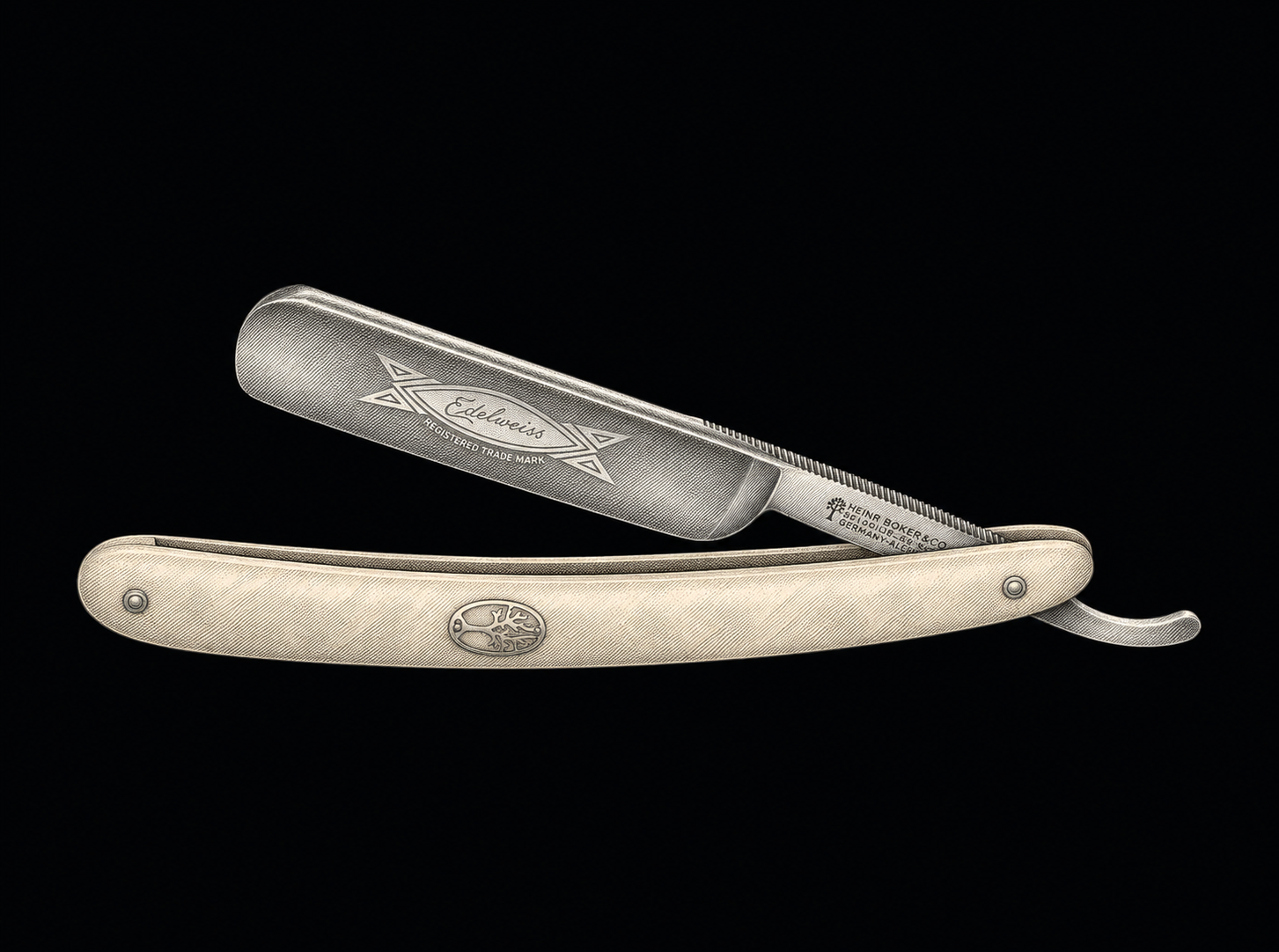
Edelweiss 5/8 (SKU 140569)
Böker
The Edelweiss is a 5/8-inch, round-point straight razor with an extra-hollow carbon-steel blade and wall. Its cream-colored synthetic scales carry a Böker tree inlay, and the manufacturer describes its negative Edelweiss etching as based on historical models.
Specifications
- Width
- 5/8″
Record details
- Grind
- Extra hollow
Record details
- Point
- Round
Record details
- Scales
- Plastic
Record details
- Scale colour
- Cream
Record details
History & details
History
A secondary trademark index lists “Boker Edelweiss” with the date 1903; this dates the indexed name entry, not the start of production of the current razor.
Design and construction
Böker specifies carbon steel for the Edelweiss blade.
Böker says the Edelweiss negative etching was crafted according to historical models; the source does not identify a specific original or date.
The cream-white scales carry a Böker tree inlay, according to the product description.
Böker describes this razor as handcrafted in Germany.
Dating and identification
Böker’s catalogue records another Edelweiss as article 140720. Its relationship to the current SKU is unresolved; the entry alone does not establish a direct revision or a simple renumbering.
Sources & record details
- Böker specifies carbon steel for the Edelweiss blade.
- Böker says the Edelweiss negative etching was crafted according to historical models; the source does not identify a specific original or date.
- The cream-white scales carry a Böker tree inlay, according to the product description.
- Böker describes this razor as handcrafted in Germany.
- A secondary trademark index lists “Boker Edelweiss” with the date 1903; this dates the indexed name entry, not the start of production of the current razor.
- Böker’s catalogue records another Edelweiss as article 140720. Its relationship to the current SKU is unresolved; the entry alone does not establish a direct revision or a simple renumbering.
About the maker
History
The Boker family registered its chestnut-tree emblem in 1674.
Böker traces its family toolmaking story to Remscheid, Germany.
Heinrich Boker established Heinr. Boker & Co. in Solingen in 1869, the foundation of the company Böker identifies as its present Solingen business.
Böker says Heinrich Boker adopted its Tree Brand to make the Solingen manufactory recognizable in growing international trade in razors, scissors, and pocket knives.
Böker reports that its Solingen factory was destroyed during the Second World War and later rebuilt by returning skilled workers.
Böker's timeline dates the destruction of its Solingen knife factory by British bombers to 1944.
Böker's timeline says rebuilding and renewed production at the Solingen Baumwerk began in 1946.
Böker dates the resumption of premium straight-razor production in Solingen, using historical designs, to 2006.
Böker says Heinrich Boker and cutlery expert Hermann Heuser founded Heinr. Boker & Co. in Solingen in 1869.
Historical context
Böker identifies 5/8 inch as the most commonly used traditional blade width.
Design and construction
Böker describes its straight-razor blades generally as extra-hollow ground with a narrow rim behind the edge. This is maker-level context, not proof of every detail on each razor.
Böker says its straight-razor blanks are forged from heated round-bar sections using a drop ram.
Böker says heat treatment is used to balance edge retention and elasticity in its razor steel.
Böker says its razor blades are hand-riveted with nickel-silver rivets, washers, spacers, and scales.
Böker says final honing is done by hand on progressively finer bench stones.
Recorded curiosities
The company says its chestnut tree was struck by lightning in 1925 and that its wood was carved into the logo at the Solingen factory entrance.
Böker describes a hand-ground finishing sequence of 18 steps for its straight-razor blanks.
Sources & record details
- The Boker family registered its chestnut-tree emblem in 1674.
- Böker traces its family toolmaking story to Remscheid, Germany.
- Heinrich Boker established Heinr. Boker & Co. in Solingen in 1869, the foundation of the company Böker identifies as its present Solingen business.
- Böker says Heinrich Boker adopted its Tree Brand to make the Solingen manufactory recognizable in growing international trade in razors, scissors, and pocket knives.
- Böker reports that its Solingen factory was destroyed during the Second World War and later rebuilt by returning skilled workers.
- Böker's timeline dates the destruction of its Solingen knife factory by British bombers to 1944.
- Böker's timeline says rebuilding and renewed production at the Solingen Baumwerk began in 1946.
- The company says its chestnut tree was struck by lightning in 1925 and that its wood was carved into the logo at the Solingen factory entrance.
- Böker dates the resumption of premium straight-razor production in Solingen, using historical designs, to 2006.
- Böker describes its straight-razor blades generally as extra-hollow ground with a narrow rim behind the edge. This is maker-level context, not proof of every detail on each razor.
- Böker says its straight-razor blanks are forged from heated round-bar sections using a drop ram.
- Böker says heat treatment is used to balance edge retention and elasticity in its razor steel.
- Böker describes a hand-ground finishing sequence of 18 steps for its straight-razor blanks.
- Böker says its razor blades are hand-riveted with nickel-silver rivets, washers, spacers, and scales.
- Böker says final honing is done by hand on progressively finer bench stones.
- Böker identifies 5/8 inch as the most commonly used traditional blade width.
- Böker says Heinrich Boker and cutlery expert Hermann Heuser founded Heinr. Boker & Co. in Solingen in 1869.
Sources
- catalog
- maker_site
- user
- book
- maker_site
- maker_site
- maker_site
- maker_site
Last updated 2026-11-15 · Suggest a correction